Hardened Container Images
Ship to government clouds faster, on images that are already secure.
Pre-hardened, FIPS-validated container images that cut remediation work, accelerate authorization readiness, and let your engineers keep building.
The Answer
Inherit, don't rebuild.
A managed hardened-image supply chain built into the Knox boundary, so compliance is inherited, not rebuilt.
The Challenge
Regulated deployments demand FIPS-compliant, continuously scanned, minimal-attack-surface images: work that drains engineering cycles and stalls authorization.
The Fudamentals
Secure base images, and why they decide your FedRAMP timeline
What are hardened container images?
Minimal, security-optimized versions of the containers your applications already run on. Unnecessary packages, shells, and tooling are stripped out to shrink the attack surface, and each image is built and signed to meet federal cryptographic standards.
Why they matter for FedRAMP
In FedRAMP and regulated environments, every container is an audit surface. Standard public images typically fail FIPS requirements and carry vulnerabilities that assessors will flag, turning a launch into months of remediation.
The Knox hardening path
From a standard image to an audit-ready one
STEP 01
Standard Images
The public base images your apps run on today: bloated and unvalidated.
STEP 02
Hardening & FIPS Validation
Strip the attack surface, swap in FIPS-validated crypto, sign and track provenance.
STEP 03
Continuous Scanning
Daily vulnerability and infrastructure scans with defined remediation timelines.
Result
Faster FedRAMP Readiness
A cleaner ATO package, fewer findings, and a defensible supply-chain story.
03 · Customer benefits
What your team inherits on day one
Built-in by design
Every image ships with FIPS-validated cryptographic modules that meet FIPS 140 production mandates out of the box. A minimal footprint means fewer packages, fewer CVEs, and a smaller vulnerability backlog for assessors to scrutinize. And because each image is signed and provenance-tracked, your supply-chain story holds up in the ATO package.
What's included
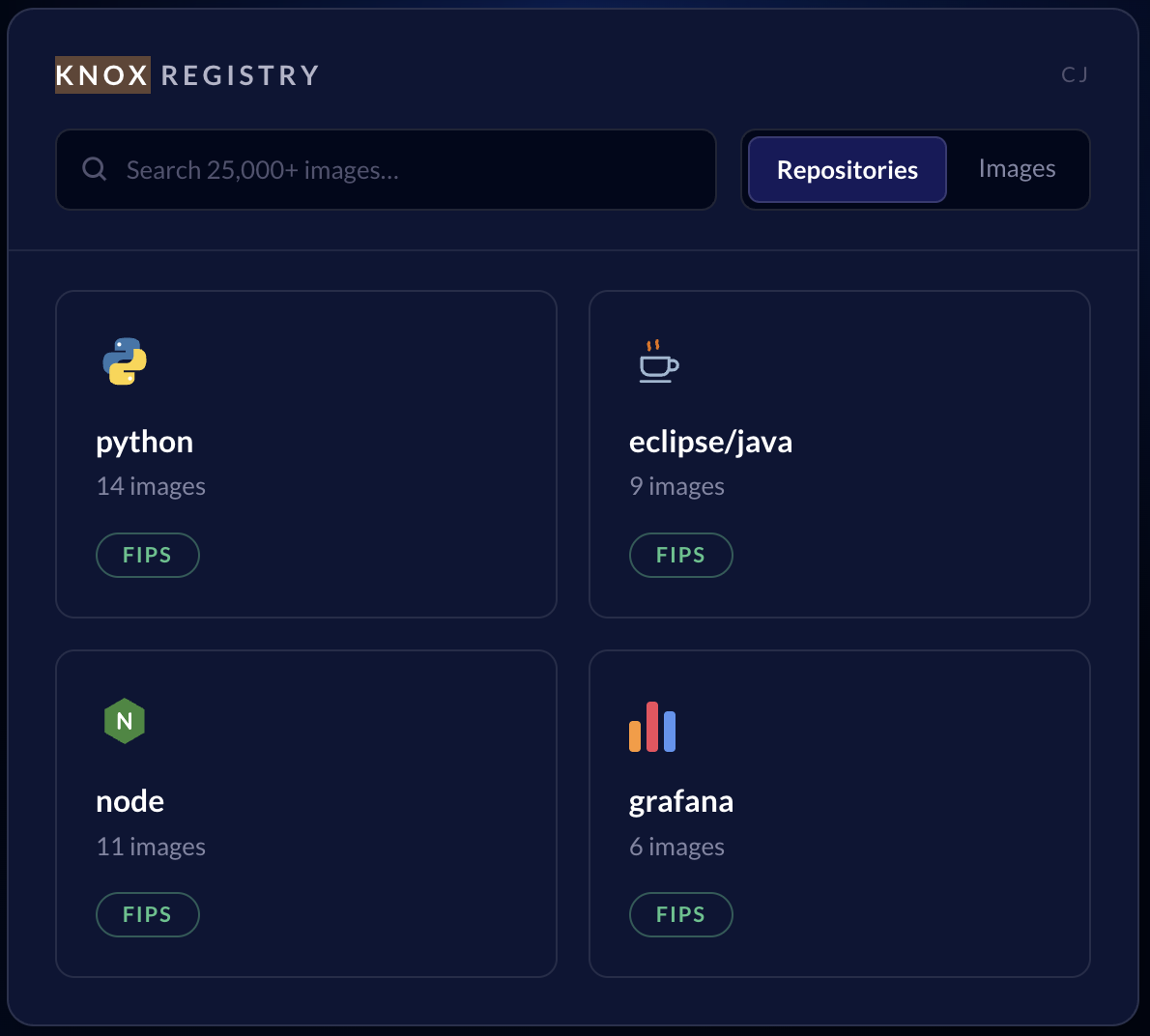
Access to a partner catalog of 25,000+ hardened images across Python, Java, Node, Grafana, Prometheus, and more
Need something custom? Custom image requests fulfilled on a ~2-week SLA
Daily vulnerability & infrastructure scanning with defined remediation timelines
Maintain development velocity while meeting regulated requirements
04 · Potential savings & ROI
Where the time and effort comes back
40–60%
Less engineering rework hardening images in-house
Weeks
Shaved off authorization readiness vs. building from scratch
↓CVEs
Lower remediation burden from a minimal attack surface
Days
To onboard new workloads onto pre-cleared images
Figures are illustrative ranges to frame value categories. Actual savings vary by stack, image count, and current compliance maturity.
05 · Example use cases
Who it's for
Scenario A · ISV
An ISV migrating a Python + Node app into GovCloud and needing FIPS images without rebuilding its pipeline.
Scenario B · Observability
An observability stack standardizing on hardened Grafana & Prometheus ahead of an ATO assessment.
Scenario C · Custom
A team needing a niche base image not in the catalog, fulfilled via the 2-week custom request SLA.
06 · Talking points
How to frame it in the conversation
Inherit, don't rebuild.
Your team keeps shipping. We deliver FIPS-validated, continuously scanned images inside the authorized boundary.
25,000+ images, ready today.
If we don't already have your stack hardened, we build it on a ~2-week SLA.
Fewer findings, faster ATO.
Minimal images mean fewer CVEs for assessors to flag and a cleaner path to authorization.
See your stack mapped to hardened images.
Book a 30-minute image-readiness review with the Knox team.